

21.01.2026
Semantic HTML refers to the practice of using HTML elements that clearly describe their meaning and role within a webpage. Instead of relying on generic containers like div and span, semantic elements communicate purpose—both to browsers and to humans. This clarity is exactly why The Importance of Semantic HTML for SEO and Accessibility has grown so much in recent years.
What Semantic HTML Means
Semantic elements tell search engines and assistive technologies what content is and how it should be interpreted. For example:
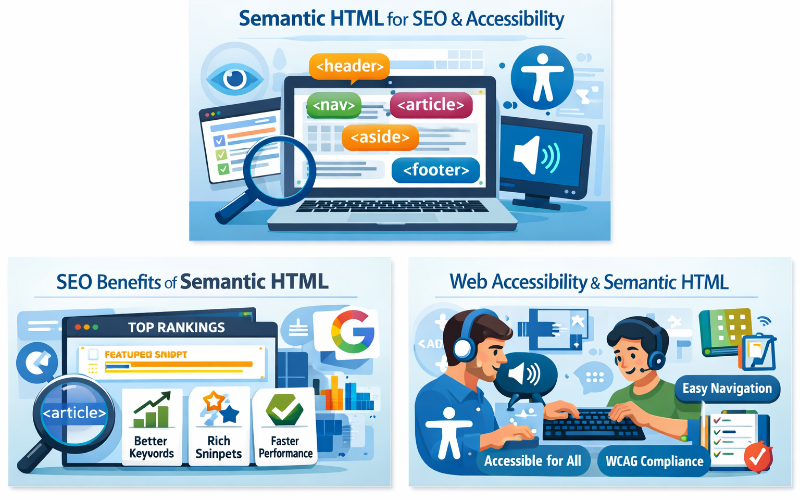
- header indicates introductory content
- nav defines navigation links
- main identifies the core content
- article represents self-contained content
These tags add meaning without extra code or scripts. They are simple, native, and powerful.
Semantic vs Non-Semantic Elements
Non-semantic elements like div and span say nothing about their content. They’re useful for styling, but when overused, they create confusion. Semantic HTML replaces ambiguity with structure, which is critical for search engines and users relying on assistive tools.
How Search Engines Read Semantic HTML
Search engines don’t just see text—they analyze structure, hierarchy, and relationships. Semantic HTML helps crawlers understand context, not just keywords.
Crawling, Indexing, and Context
When a crawler encounters article or section, it understands content boundaries. Headings (h1–h6) signal importance. Navigation is clearly separated from main content. This clarity makes indexing more accurate and efficient.
Structured Content and Rankings
Well-structured pages tend to:
- Load faster
- Have lower bounce rates
- Earn better engagement signals
All of these indirectly support higher rankings, reinforcing The Importance of Semantic HTML for SEO and Accessibility in modern optimization strategies.
The SEO Benefits of Semantic HTML
Semantic HTML doesn’t magically rank a page, but it creates the conditions for strong SEO performance.
Improved Keyword Context
Search engines can better associate keywords with topics when content is wrapped in meaningful tags. For example, keywords inside article and h2 carry more contextual weight than text buried in random div elements.
Rich Results and Featured Snippets
Clear markup improves eligibility for:
- Featured snippets
- Sitelinks
- Other enhanced SERP features
Combined with structured data, semantic HTML boosts visibility without violating search engine guidelines.
Accessibility: Building Inclusive Experiences
Accessibility isn’t optional—it’s essential. Semantic HTML is one of the most effective and affordable ways to make websites usable for everyone.
Screen Readers and Assistive Technology
Screen readers rely heavily on semantic elements to announce page structure. Landmarks like nav and main let users jump directly to relevant sections, saving time and reducing frustration.
Keyboard Navigation and Landmarks
Semantic elements support logical tab order and keyboard navigation. Users who can’t use a mouse benefit instantly—no extra scripts required.
Core Semantic HTML Elements You Should Use
- Header, Nav, Main, Footer – Define layout and page flow
- Article, Section, Aside – Organize content meaningfully
- Figure, Figcaption, Time – Improve media and content clarity
Common Mistakes That Hurt SEO and Accessibility
- Div overuse that removes meaning
- Skipping heading hierarchy (e.g., h1 → h4)
- Ignoring landmarks needed by assistive tech
Semantic HTML and Modern Frameworks
Frameworks don’t replace semantics—they depend on them.
React, Vue, and Angular Best Practices
Even in component-based development, semantic tags should wrap components correctly. All modern frameworks support semantic HTML with no performance penalty.
Testing and Validation Tools
- W3C Validator – Checks markup accuracy
- Lighthouse – Audits SEO, accessibility, and performance
Frequently Asked Questions (FAQs)
1. Why is semantic HTML important for SEO?
It helps search engines understand structure and context.
2. How does semantic HTML improve accessibility?
It allows assistive technologies to navigate content accurately.
3. Does semantic HTML replace ARIA?
No. Semantic HTML comes first; ARIA fills gaps when needed.
4. Can I use semantic HTML in frameworks?
Yes. All modern frameworks fully support it.
5. Does semantic HTML affect page speed?
Indirectly, by reducing unnecessary complexity.
6. Is semantic HTML required for accessibility compliance?
It’s a foundational requirement for WCAG standards.
Conclusion: Future-Proof Your Website
In today’s competitive digital space, The Importance of Semantic HTML for SEO and Accessibility cannot be overstated. It strengthens search visibility, enhances usability, supports inclusivity, and prepares websites for future standards—all without adding complexity.